
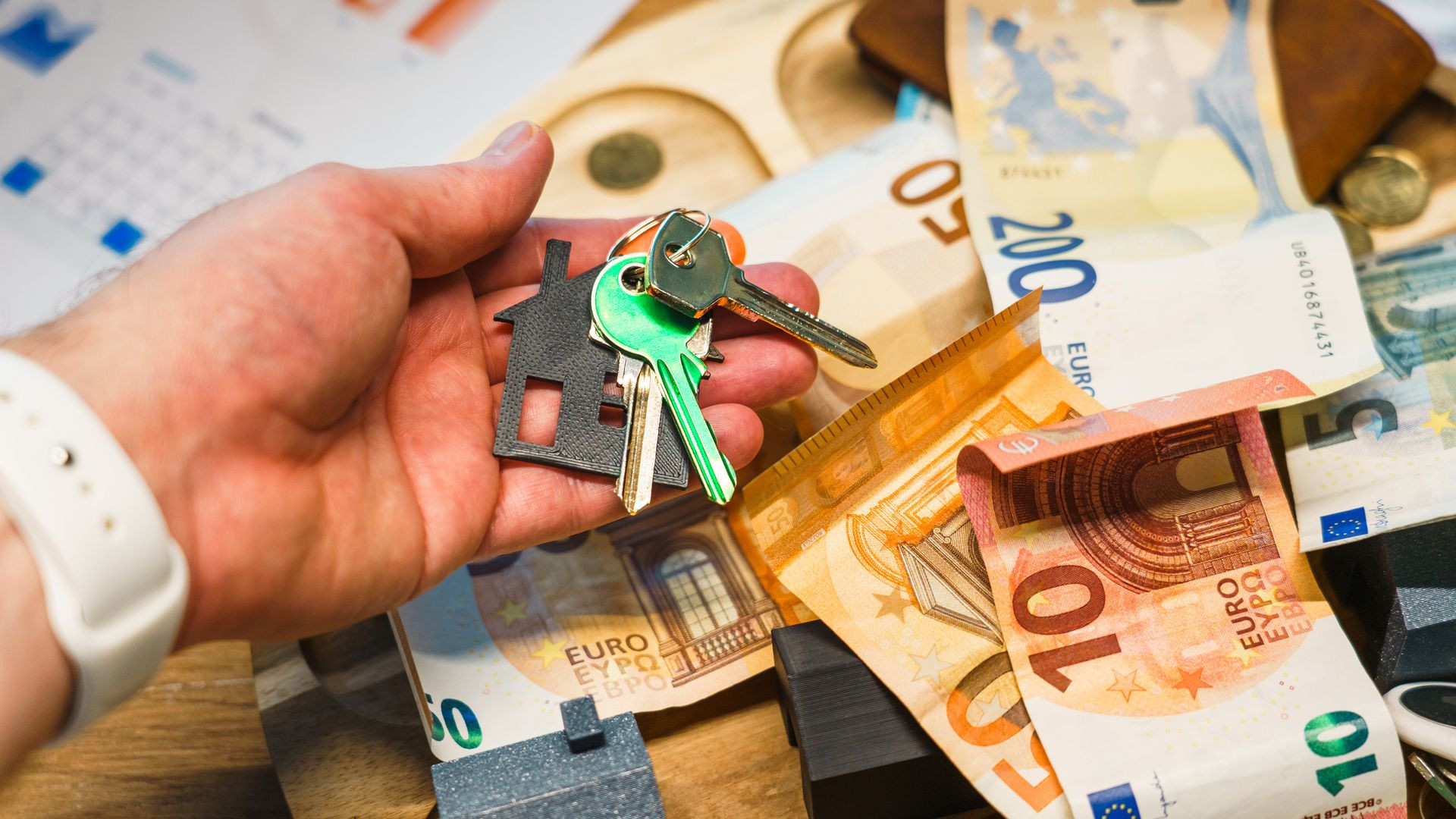
Buying property outright in Spain: negotiation, funds, strategy
points
Buying outright in Spain gives you a real bargaining advantage: in the first quarter of 2026, the average discount on the asking price stood at 7 per cent in Spain and 6 per cent in Málaga
(idealista/data), and a buyer without a loan condition attached secures the top end of the price range. Buying without a mortgage saves 1–2 per cent of the price
(valuation, arrangement fee, insurance) and reduces the timeframe to 4–6 weeks. On the other hand, the Anti-Money Laundering Act (Ley 10/2010
) requires proof of the source of funds, and payment must be made by bank transfer or cheque.
Updated in September 2026 — data verified on that date.
Buying property in Spain with cash: advantages, strategy and points to bear in mind
Many French and Belgian buyers on the Costa del Sol pay without taking out a loan: proceeds from selling a property back home, savings, or an inheritance. A cash purchase (pago al contado) is not merely the absence of a loan; it is a negotiating position, a shorter timeline and a set of banking compliance documents to prepare before finding the property. This page details the benefits of paying in cash, what the law requires in return, how to transfer funds and when taking out a loan remains the best decision.
Buying with cash is one of the four financing options in our guide to budgeting and financing a property purchase in Spain, alongside the Spanish mortgage for non-residents and a loan secured against a property in France or Belgium.
Buying with cash in Spain: a major negotiating advantage
A cash buyer secures better terms because they eliminate the seller’s main risk: a rejected loan application. The ‘contrato de arras’ (deposit agreement) binds both parties; a buyer who still needs to secure a mortgage negotiates a condition precedent that many sellers refuse, or risks forfeiting their deposit. Paying in cash removes this issue and allows the ‘escritura’ to be signed within four to six weeks, compared with eight to twelve weeks when financing is involved.
There is scope for negotiation. According to idealista/data, 14 per cent of Spanish property listings reduced their asking price between January and March 2026, by an average of 7 per cent (€29,390); in Málaga, 18 per cent of listings fell by 6 per cent (€26,854). These figures reflect the price reduction before negotiations: the final discount secured by a well-advised and swift cash buyer is added on top, typically ranging from 3 to 10 per cent depending on the property and how long the listing has been active.
Ask your bank to prepare a certificate of available funds before making your first offer. Presented alongside the ‘contrato de arras’ (deposit agreement) and a 30-day signing commitment, this is often worth more than a 2 per cent higher offer accompanied by a financing clause. This is a standard practice in our buyer agent approach.
The tangible savings of buying without a mortgage
Buying with cash saves on mortgage-specific costs – typically 1–2 per cent of the price, depending on the bank – and avoids the recurring fees associated with a loan. Since Law 5/2019 came into force, Spanish banks have covered the costs of the notary, the land registry, the administrative agency and the AJD (stamp duty) on the loan; the borrower remains responsible for the valuation, the arrangement fee and the insurance policies that the bank makes conditional on the interest rate. The purchase costs themselves (7 per cent ITP or 10 per cent VAT + 1.2 per cent AJD, notary, land registry and solicitor’s fees) remain unchanged.
The downside of not having a valuation: no one assesses the property for you. Cash buyers organise their own technical, legal and price checks, which is what our Property Check 360° covers.
Proving the source of funds: a legal obligation
Proving the source of funds (justificación del origen de los fondos) is a legal obligation for any property purchase in Spain, and it places a greater burden on cash buyers, as they have not been screened by a lending bank. Law 10/2010 on the prevention of money laundering lists notaries, registrars, developers and estate agents among the obliged parties: each must verify your identity, identify the beneficial owner and ascertain the source of the funds, under the supervision of SEPBLAC.
In practice, Spanish banks will block a large incoming transfer until they have received the necessary documentation, and the notary will record each method of payment in the escritura. Prepare your documents before making the transfer:
: The last two tax assessment notices, bank statements from the sending account covering six to twelve months, a notarised deed of sale if the funds come from the sale of a property, a deed of gift or declaration of inheritance, and balance sheets for a company director.
: tax assessment notices, bank statements, deed of sale or deed of gift, certificate from the Belgian notary in the case of an inheritance. Spanish banks often require a certified translation of the documents into Dutch.
Cash payments are capped at €1,000 whenever a professional is involved (estate agent, developer) and at €10,000 when the payer is a natural person who is not a tax resident in Spain, according to the Agencia Tributaria (Law 7/2012, as amended by Law 11/2021). Any cash amount of €10,000 or more brought into Spain must be declared (form S1). A property purchase must be paid for by bank transfer or bank cheque, without exception.
Transferring funds to Spain: the rules
Funds from a French or Belgian buyer are transferred in euros via SEPA transfer, with no currency conversion or additional charges, within one to two working days. Three rules will help avoid any hold-ups: transfer from an account in your name to an account in your name; notify your home bank (online transfer limits) and the Spanish bank of the amount and date. On the day of the escritura, the price is paid by a bank cheque drawn on your bank account in Spain or by an immediate bank transfer.
| Method of payment | Timeframe | Approximate cost | Usage |
|---|---|---|---|
| SEPA transfer from France or Belgium | 1–2 working days | €0–5 | Top up the Spanish account |
| OMF transfer (Bank of Spain) | Same day | €20–60 | Large amounts, signature required |
| Bank cheque | Issued within 24–48 hours | 0.1–0.5%, capped depending on the bank | Payment of the purchase price before a notary |
| Conversion from CHF, GBP or USD | 1–3 days | Exchange margin 0.3–2 per cent | Choose a currency exchange broker over a bank |
When should you take out a loan even if you can pay in cash?
Taking out a loan when you can pay in cash is justified in three cases: a property intended for letting, assets you’d rather keep invested and, for French nationals, property wealth tax. A non-EU resident who rents out a property can deduct the loan interest from their Spanish rental income, which reduces the IRNR by 19 per cent; a property for personal use offers no such deduction, as explained on our page on taxation for non-residents in Spain. A Belgian, who is not subject to wealth tax, focuses primarily on return: at an average rate of 2.96 per cent (INE, June 2026), taking out a mortgage is only worthwhile if the capital retained yields a higher return, net of tax.
- → A second home for personal use
- → You want to negotiate quickly and aggressively
- → Your investments yield less than 3 per cent net
- → The property will be let: interest is deductible from the IRNR
- → You are liable for the IFI in France: the purchase debt is deductible
- → Your capital is invested at a net rate of over 4 per cent
Cash purchase via an SCI or company: the implications
Buying outright via a French SCI or a Belgian company is rarely advantageous for a property for personal use in Spain. Spain does not recognise the tax transparency of an SCI: the company is treated as a non-resident entity, with its own reporting obligations. The resale of shares is taxable in Spain in the same way as the sale of the property itself (France-Spain double taxation agreement, Article 13), and the use of the property by the shareholders of a Belgian company may be reclassified as a benefit in kind. This is only relevant in cases of organised transfers or joint ownership; the tax implications should be assessed with a tax adviser in both countries before signing.
Buying with cash in Spain: your questions
Do you need to prove the source of the funds to buy a property in Spain for cash?
Yes, this is a legal requirement under Ley 10/2010 on the prevention of money laundering. The Spanish bank receiving the funds and the notary must identify the buyer and document the source of the money: tax assessment notices, bank statements, deeds of sale for a property, deeds of gift or inheritance certificates. Without these documents, the bank will block the transfer and the signing will be postponed.
Can you pay for a property in cash in Spain?
Not in practice. The law caps cash payments at €1,000 whenever a professional is involved (estate agent, developer) and at €10,000 for an individual who is not a tax resident in Spain; above these limits, the fine amounts to 25 per cent of the sum. The notary records the method of payment for every euro in the escritura: a property purchase must be settled by bank transfer or bank cheque.
Is buying with cash always preferable to taking out a loan?
No. For a property let out, the interest on the loan is deductible from rental income subject to IRNR tax (for EU residents), and for a French national liable for IFI, the debt incurred on the purchase reduces the taxable base. If your capital yields more than the interest rate on the loan (2.96 per cent on average in June 2026 according to the INE), the leverage effect takes precedence. For a second home for personal use, paying in cash remains the simplest and least expensive option.
Paying in cash does not exempt you from any checks, as no bank will inspect the property on your behalf. An independent solicitor to handle the deed, a full inspection of the property and an estate agent who negotiates solely in your best interests, at no extra cost: this is how the advantage of paying in cash becomes a cost.
Where Real Estate Feels Right
NOMA guides you every step of the way in your real estate project on the Costa del Sol.
Talk about my project