
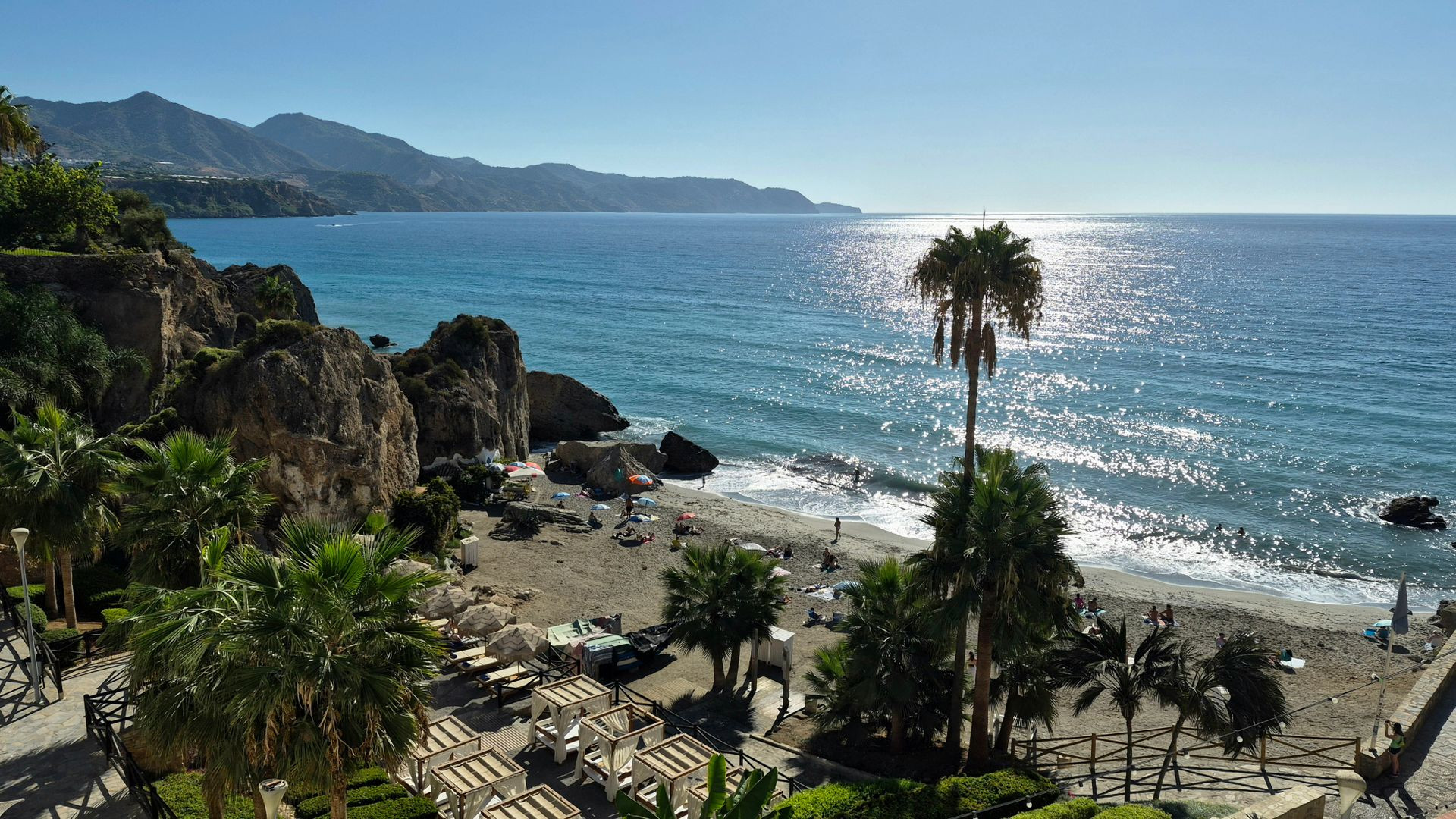
Eastern Costa del Sol and Axarquía: property from Málaga to Nerja
The Eastern Costa del Sol stretches from Málaga to Nerja, with the Axarquía forming the hinterland of rolling hills, avocado groves and whitewashed villages. In August 2026, the average price ranges from €3,155 per square metre in Torrox
and €
3,448 per square metre in Torre del Mar
to €3,952 per square metre in Nerja
, with Málaga city at €3,938 per square metre (idealista): 25 to 45 per cent lower than in Marbella
. This is the most ‘Spanish’ part of the coast, 15 minutes (Málaga) or 55 minutes (Nerja) from the airport, with no rail link to the east of the capital, where foreign demand already exceeds 50 per cent
in Nerja and Frigiliana.
Updated in September 2026 — data verified on that date.
Eastern Costa del Sol and Axarquía: buying between Málaga and Nerja, the property guide
The Eastern Costa del Sol is the stretch of Málaga’s coastline situated to the east of the capital, extending as far as the border with the province of Granada. In our comparison of areas to buy in on the Costa del Sol, we describe it as the ‘authentic yet accessible’ option; this page details the towns, prices as of August 2026, buyer profiles, access and key considerations for a region where the countryside begins just five kilometres from the beach.
For a French or Belgian buyer, the east is chosen for what it isn’t: neither Marbella nor the international residential developments of Mijas Costa. Life here is lived in Spanish; prices are 25 to 45 per cent lower than in Marbella; and residents are less likely to expect new-build properties, fewer services in English and, once past Rincón de la Victoria, a considerable distance to the airport. This section of our guide to buying property on the Costa del Sol links to the four pages covering towns in the area.
What is the Axarquía, and where does the Eastern Costa del Sol end?
The Axarquía is the comarca comprising 31 municipalities that occupies the south-eastern corner of the province of Málaga, between the sea, the Málaga mountains and the Sierra de Tejeda-Almijara. Its capital is Vélez-Málaga, its seaside resort is Torre del Mar, its coastal towns include Rincón de la Victoria, Algarrobo, Torrox and Nerja, and its hilltop villages include Frigiliana, Cómpeta, Sayalonga and Canillas de Albaida. The Eastern Costa del Sol, as defined by estate agents, also includes the eastern neighbourhoods of Málaga city: La Malagueta, Pedregalejo, El Palo and Cerrado de Calderón, in the ‘Este’ district.
The landscape changes rapidly. Just ten minutes from the beach, the hills of Vélez and Torrox are covered with avocado and mango orchards, subtropical crops that have made the Axarquía Europe’s leading producer of avocados and mangoes, and which consume a large proportion of the water from the La Viñuela reservoir. The white villages have retained their Spanish population; Torrox Costa (with a German community) and Nerja (with a British community) are the only two truly international areas in the region.
Property prices by location in August 2026
In August 2026, the average asking price on the Eastern Costa del Sol ranged from €3,155/m² in Torrox to €3,952/m² in Nerja, with Málaga city at €3,938/m², Rincón de la Victoria at €3,545 per square metre and Torre del Mar at €3,448 per square metre, according to the idealista report for the province of Málaga. The recovery is well under way: +13.4 per cent in Rincón, +11.2 per cent in Torre del Mar, +25.4 per cent in the municipality of Vélez-Málaga and +23.7 per cent in Cómpeta over the past twelve months, compared with +4 per cent in Marbella. The starting point remains low: the municipality of Vélez-Málaga, excluding Torre del Mar, is trading at €2,188 per square metre.
| Municipality | Average price August 2026 | 12 months | Districts (idealista, August 2026) |
|---|---|---|---|
| Málaga city | €3,938/m² | +5.1% | Este €4,990/m², Centro €4,574/m², Carretera de Cádiz €4,191/m², Ciudad Jardín €2,715/m² |
| Rincón de la Victoria | €3,545 per m² | +13.4% | Playa del Rincón €3,910/m², La Cala del Moral €3,641/m², Añoreta Golf €2,955/m² (+23.9%) |
| Torre del Mar (Vélez-Málaga) | €3,448/m² | +11.2% | Paseo Marítimo de Levante €3,903/m², Centro €3,474/m²; municipality of Vélez-Málaga €2,188/m² |
| Torrox | €3,155/m² | +6.8% | Centro Internacional €3,913/m², El Peñoncillo €3,803/m², El Morche €3,270/m², Torrox Pueblo €2,266/m² |
| Nerja | €3,952 per m² | +4.4% | Burriana €4,965/m², Capistrano €4,344/m², Centro €3,786/m² |
| Frigiliana / Cómpeta | €3,248 / €1,949 per m² | +1.0% / +23.7% | Inland villages: village houses and fincas, niche market |
| Province of Málaga | €4,293 per m² | +7.4% — idealista average, August 2026 | |
These are asking prices; there is greater scope for negotiation than in the west for older properties in Torrox Costa or El Morche. And the difference between coastal and inland areas is considerable: €3,913 per m² at the Centro Internacional de Torrox compared with €2,266 per m² in the village, four kilometres away. Our page on property prices on the Costa del Sol puts these figures into context for the coast as a whole.
From Málaga to Nerja: the four towns of the Eastern Costa del Sol
The Eastern Costa del Sol comprises four areas, each detailed on its own page: the city centre and its eastern districts, the seaside suburb of Rincón, the Torre del Mar–Torrox corridor including the hinterland, and Nerja with Frigiliana.
City and culture
Families
Affordable prices
An authentic retirement destination
Who will be buying on the Eastern Costa del Sol in 2026?
Buyers on the Eastern Costa del Sol are more often year-round residents and retirees than investors, and the proportion of foreign buyers varies from one-tenth to four times the local figure depending on the location. According to idealista/news (August 2026), demand from abroad accounts for 14.8 per cent of enquiries for property in Málaga city — with Americans, Britons and Dutch leading the way —, 50 to 60 per cent in Nerja and Frigiliana, and over 60 per cent in Cómpeta, compared with a provincial average of 27.1 per cent. The east is therefore ‘unspoilt’ only as far as Torrox: Nerja and the villages in the Sierra are already international markets.
NOMA has identified three main profiles there. The retired French or Belgian couple who want to live in a Spanish-speaking environment, with a budget of €250,000 to €400,000, and choose Torre del Mar, Torrox or a village in the Axarquía. The family where one parent works in Málaga or whose children attend the Lycée Français International de Málaga, an AEFE-accredited school located in Cerrado de Calderón, in the eastern district: they look at El Palo, Pedregalejo or Rincón de la Victoria. And the second-home buyer who prefers coves to golf courses and is looking at Nerja, Capistrano or Frigiliana – a rare find, with challenging terrain included.
A retired couple from Liège have €330,000 available, including fees, which amounts to approximately €300,000 net after a 7 per cent ITP and associated costs for an older property. In Torrox (€3,155/m²), this represents around 95 m²; in Torre del Mar (€3,448/m²), 87 m²; in Rincón (€3,545/m²), 85 m²; in Nerja (€3,952 per m²), 76 m² — and 45 m² on Marbella’s Golden Mile. For the same budget, you can buy a 120 m² village house with a patio in Cómpeta or Sayalonga, 25 minutes from the sea via a mountain road.
Pros and cons: authenticity, price, water and distance
The Eastern Costa del Sol offers prices 25 to 45 per cent lower than in Marbella, a year-round Spanish way of life and a coastline sheltered from the northerly winds by the Sierra de Tejeda-Almijara (Torrox claims to have ‘the best climate in Europe’, a municipal slogan that’s something of an exaggeration); in return, it has a limited supply of new-build properties, rugged terrain and, beyond Rincón, a considerable distance to the airport and international services.
The lowest entry prices on the coast, alongside Manilva; towns inhabited all year round (Torre del Mar, Vélez, Rincón); the Axarquía Regional Hospital in Vélez-Málaga and the university hospitals in Málaga; the A-7 motorway is toll-free as far as Nerja; the coves of Maro, white villages, and local cuisine; the city of Málaga as a hub for employment, culture and transport (AVE, metro, port).
No trains east of Málaga; Nerja is 55 minutes from the airport; few new-build developments and few international schools outside Málaga; the Torrox Costa and El Morche housing estates date from the 1970s and 1980s; steep slopes in Nerja, Capistrano and the villages; recurring droughts in the Axarquía; a tourism moratorium in Málaga city.
As for water, following nearly two years of restrictions (swimming pools, beach showers, fountains) introduced in May 2024 during a severe shortage, Axarquía lifted the restrictions on 27 March 2026, as La Viñuela reached 148.6 hm³ (InfoAxarquía). Anyone buying a villa with a swimming pool or an irrigated finca must take this cycle into account: it will happen again.
Access and infrastructure: A-7, N-340, airport and French Lycée
The Eastern Costa del Sol can be reached via the A-7, a toll-free motorway that bypasses Málaga and runs on to Nerja and Almuñécar, and via the N-340, the old coastal road that passes through all the seaside towns. From Málaga Airport, allow around 15 minutes to reach the centre of Málaga, 25 minutes to Rincón de la Victoria, 40 to 45 minutes to Torre del Mar and Torrox Costa, 55 minutes to Nerja and 65 minutes to Frigiliana (approximate journey times, excluding traffic). There are no trains serving the coast east of the capital: the Cercanías C-1 line runs westwards, and the Nerja–Algeciras coastal railway is still at the planning stage, with no funding secured as of May 2026. Alsa buses run from Málaga to Torre del Mar, Torrox and Nerja.
| Town | Málaga Airport | Main public hospital | Landmark |
|---|---|---|---|
| Málaga East (El Palo, Pedregalejo) | ≈ 15–20 mins | Regional Hospital / Clínico (Málaga) | French International School of Málaga (AEFE) in Cerrado de Calderón |
| Rincón de la Victoria | ≈ 25 mins | Málaga | City and intercity buses to Málaga; private bilingual schools |
| Torre del Mar / Vélez-Málaga | ≈ 40 mins | Axarquía Regional Hospital (Vélez) | A lively town all year round, with a long seafront promenade |
| Torrox Costa | ≈ 45 mins | Vélez-Málaga | German community, market for second homes |
| Nerja / Frigiliana | ≈ 55–65 mins | Vélez-Málaga (approx. 30 mins) | Granada Airport ≈ 1 hr 30 mins away, limited connections |
Investing in the Axarquía: an emerging trend, with two caveats
The Axarquía is attracting more and more investors due to its low entry price and double-digit price rises, but the gross rental yield there is lower than in the centre: around 4.3% in Nerja, 4.5% in Rincón, 4.8 per cent in Torrox and 5 per cent in Málaga city for long-term lets (NOMA calculation: idealista average rent for August 2026 × 12 / average purchase price). Rents are low here — €12.5/m²/month in Torrox, €14.2 in Nerja, compared with €23.7 in Marbella — and the long-term rental market is limited outside Málaga and Vélez.
First caveat: on 22 August 2025, Málaga city introduced a moratorium, which could last three years, on any new registrations of holiday accommodation, whilst 53 neighbourhoods already had more than 8 per cent of their housing stock comprised of holiday accommodation, according to El Español. Mayor Francisco de la Torre justified the measure by citing the need to “reconcile tourism with the need for a strong residential supply” (translated from Spanish). An apartment purchased in the city centre or in La Malagueta for short-term let will therefore not be granted a licence. Second caveat: the resale market is sluggish outside Nerja and Málaga. The areas best suited to investment are compared in our selection of the best areas to invest in on the Costa del Sol.
Points to bear in mind before buying in the Axarquía
The pitfalls of the eastern Costa del Sol relate to rural land, the topography and the age of coastal buildings. The Axarquía has several thousand houses built without a licence on land not zoned for development between the 1990s and 2000s; many of which have been regularised via an AFO certificate (asimilado a fuera de ordenación), which is not a planning permission: it prohibits any extensions, restricts utility connections and complicates bank financing. Spanish notaries do not check this; your independent solicitor must obtain the planning certificate from the local council before the deposit is paid. Our page on buying a finca in Spain details the difference between ‘suelo urbano’, ‘urbanisable’ and ‘rústico’.
On the coast, properties in Torrox Costa, El Morche and Algarrobo Costa often date from the 1970s and 1980s: ask for the technical inspection (ITE) if it is due, the last three minutes of meetings and the community’s debt certificate. In Nerja, Capistrano and the surrounding villages, check the gradient: a house 200 metres from the beach may have a 60-metre drop, which makes all the difference after 70 years. A 360° Property Check covers planning compliance, the condition of the building and service charges before making an offer.
In rural areas, many fincas rely on a well, an irrigation community (comunidad de regantes) and a septic tank: ensure these rights are included in the due diligence before signing.
Who is the Costa del Sol East aimed at?
The Costa del Sol East is ideal for buyers who want to live in Spain year-round on a modest budget, and for those who work or send their children to school in Málaga; it is less suitable for those looking for new-build properties, golf courses, an established French-speaking community or a high rental yield.
- → You’re looking for a Spanish retirement with mild winters and low prices: Torre del Mar, Torrox, villages in the Axarquía
- → Your children will be attending the French Lycée in Málaga: El Palo, Pedregalejo, Rincón de la Victoria
- → You’re looking for views, coves and charm: Nerja, Capistrano, Frigiliana
- → You’re making a long-term investment in a university city: Málaga
- → You’re looking for new-build properties, golf and French-speaking neighbours: the western Costa del Sol, from Estepona to Benahavís
- → You’re looking for short-term lettings near the airport: the Central Costa del Sol, from Torremolinos to Fuengirola
- → You don’t want to rely on a car outside Málaga: Fuengirola or Benalmádena, accessible by train
- → A quick resale is a priority: Marbella
Spend a week out of season in your shortlisted village or neighbourhood, and make the journey from the airport to your home on a Friday evening in August: the East is chosen for its way of life, which you should experience before signing on the dotted line. This is one of the steps in the NOMA method, and a question that SOL, NOMA’s online assistant, systematically asks buyers who are torn between Nerja and Estepona.
The Eastern Costa del Sol and Axarquía: your questions
What are property prices in the Axarquía in 2026?
In August 2026, the average asking price is €3,155 per square metre in Torrox, €3,448 per square metre in Torre del Mar, €3,545 per square metre in Rincón de la Victoria, €3,952 per square metre in Nerja and €3,938 per square metre in Málaga city (idealista). The inland villages are significantly cheaper: €2,266 per square metre in Torrox Pueblo, €1,949 per square metre in Cómpeta, and €2,188 per square metre in the municipality of Vélez-Málaga, excluding Torre del Mar. Annual price rises are sharp (+13.4 per cent in Rincón, +25.4 per cent in Vélez-Málaga) but are starting from a low base.
Is the Axarquía well connected?
By road only. The toll-free A-7 motorway connects Málaga Airport to Rincón in 25 minutes, to Torre del Mar in 40 minutes and to Nerja in around 55 minutes. There are no trains running east of Málaga and the coastal rail link is still under consideration; Alsa buses serve the coastal towns. The main public hospital for the region is the Hospital Comarcal de la Axarquía, in Vélez-Málaga.
Is there a sufficient supply of new-build properties on the Eastern Costa del Sol?
No, it is significantly more limited than in the west and centre. New-build properties are concentrated in Málaga city, Rincón de la Victoria and around Torre del Mar; Nerja and Torrox are seeing a few new developments emerge, but the bulk of the coastal housing stock dates from the 1970s to the 2000s, and the villages offer only older properties. A buyer looking for a new-build with guarantees will find more choice between Estepona and Mijas.
Where Real Estate Feels Right
NOMA guides you every step of the way in your real estate project on the Costa del Sol.
Talk about my project